Cost of Memory Care in Brooksville, FL: What Families Should Budget
Tampa Area assisted living and nursing home figures can frame a Brooksville memory care budget without inventing a local memory care median.
Families researching the cost of memory care in Brooksville FL often find assisted living numbers, nursing home numbers and very different definitions of memory support. A sound budget therefore uses the Tampa Area assisted living median as a floor reference and Tampa Area nursing home figures as an upper reference, while treating neither as a quote for memory care.
The Hacienda House, on Powell Road, is a small Florida Adult Family-Care Home with 4 beds listed on its own site. It offers assisted living style support, memory care support and respite stays. Its size and license type make a written, individualized quote especially important.
Start with the support needed, not a promised price
Memory care is best understood as supervision, personal support and an environment planned around cognitive changes. It is not a promise to improve memory or change the course of a condition. One person may mainly need cueing, meals and help maintaining a routine. Another may need closer supervision, hands-on personal care and an environment designed to reduce unsafe exit-seeking.
Before comparing prices, list the help needed now and the situations that are becoming difficult at home. Include bathing, dressing, eating, mobility, medication routines, nighttime supervision and response to confusion. Then ask each provider which parts of that list are included. This keeps the conversation focused on actual support rather than on a memory care label alone.
Cost of memory care in Brooksville FL: local reference points
The supplies assisted living and nursing home benchmarks, but no separate memory care median. There is no Brooksville city median in these figures, so the Tampa Area is the local reference used for Hernando County. Florida and national figures provide broader comparisons.
| Service and region | Monthly figure | Annual figure |
|---|---|---|
| Assisted living, Tampa Area | $5,000 | $60,000 |
| Assisted living, Florida statewide | $5,610 | $67,320 |
| Assisted living, U.S. national | $6,200 | $74,400 |
| Nursing home semi-private room, Tampa Area | $9,885 | $118,625 |
| Nursing home private room, Tampa Area | $12,015 | $144,175 |
The nursing home figures are an upper reference for a different, more institutional level of care. They do not create a predicted memory care range, and they are not rates for The Hacienda House. Supervision needs, the setting and the pricing model still determine an actual quote.
What drives memory care pricing
Supervision is usually central. A person who needs frequent redirection, hands-on personal care or close attention during the night may require a different care plan from someone who needs reminders and a consistent routine. The physical environment also matters. Families may see features intended to support safe movement, manage exits and reduce confusion, although these features vary by provider.
- How much hands-on help is needed with daily activities
- Whether supervision needs change during evenings or overnight
- How staff are trained for dementia-related communication and behavior
- Whether the environment is secured and how that works in practice
- Whether smaller groups or individualized routines affect the care plan
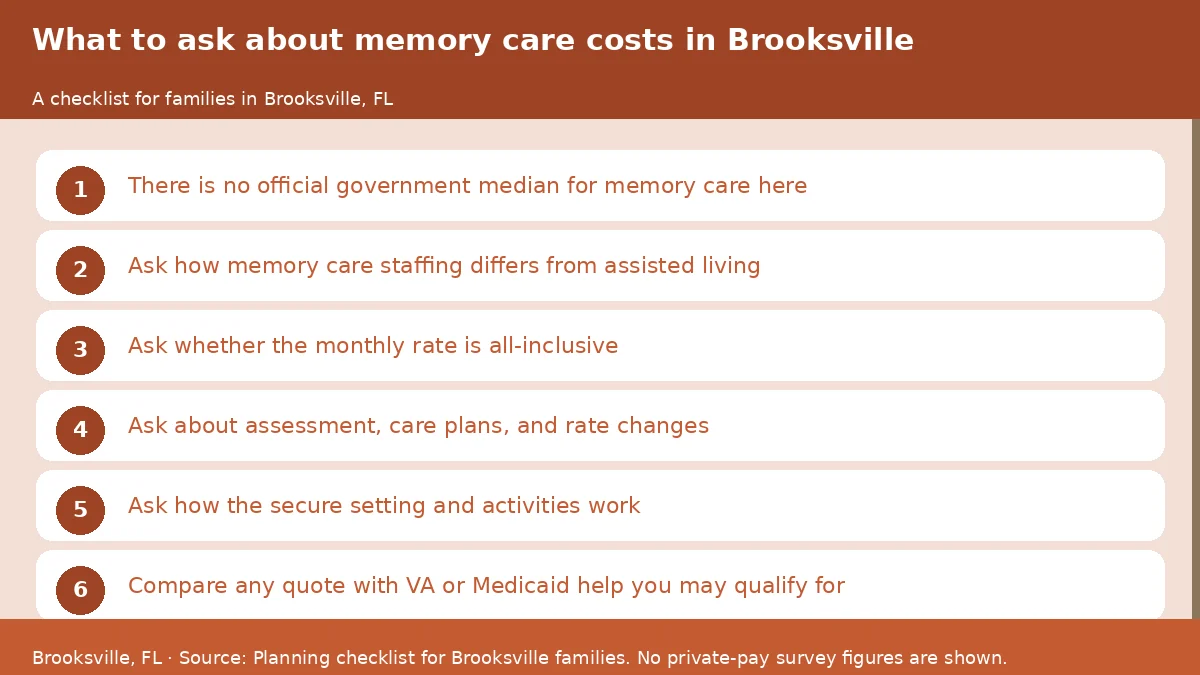
Ask for examples rather than relying on broad terms. A useful discussion covers who provides support, how changes are communicated and what happens if needs increase. Memory support should be described honestly as supervision and environmental support, not as a treatment outcome.
All-inclusive pricing versus base plus care levels
An all-inclusive model generally combines the residence and a defined group of services in one recurring charge. A base-plus-care-level model starts with basic accommodations and adds charges according to assessed needs. Neither label guarantees that every service is covered. Supplies, transportation, medication-related services or a higher level of supervision may be handled differently.
Request a written service schedule and ask how reassessments work. Also ask about deposits, initial charges, respite billing, annual adjustments and the notice given before a change. If a quote uses care levels, ask for plain-language examples of what places a resident at each level and whether the family receives an updated care plan before the charge changes.
Families can review assisted living at The Hacienda House and its approach to memory care support as background for that conversation. For current rates and a written explanation of inclusions, call The Hacienda House at (352) 652-8436. Regional medians cannot substitute for that quote.
Compare home care and adult day care carefully
These are not memory care prices. Home care comparisons should also account for housing, food, utilities and supervision outside purchased shifts. Adult day care can provide daytime structure, but it does not by itself cover overnight needs.
Florida licensing and dementia-care questions
The Florida Agency for Health Care Administration distinguishes assisted living facilities licensed under Part I of Chapter 429 from Adult Family-Care Homes under Part II. AHCA describes an AFCH as a private home where the licensee lives and cares for up to five residents. The Hacienda House identifies itself under this smaller license type, with 4 beds listed on its site.
Florida also requires Alzheimer’s disease and related dementia training for staff in facilities that advertise memory care. That training requirement should not be confused with specialty assisted living licenses such as Extended Congregate Care, Limited Nursing Services or Limited Mental Health.
For any Brooksville or Spring Hill provider, ask to see the applicable license and ask who lives on the premises, how supervision is organized, what dementia training staff receive and how the environment is managed. In a small home, it is also reasonable to ask how routines, absences and changes in care needs are handled without assuming that a large-facility model applies.
Medicare, Medicaid, insurance and Veterans benefits
Medicare’s long-term care guidance says Medicare does not cover long-term custodial care when that is the only care needed, and most long-term care is custodial. Families should not assume that a dementia diagnosis makes residential room, board and daily supervision a Medicare-covered expense.
Florida Medicaid and long-term care insurance
Florida’s Statewide Medicaid Managed Care Long-Term Care program can cover services including assisted living services, personal care, adult day care and respite for eligible people who need a nursing facility level of care. Age and disability rules apply, enrollment is limited and there is a waitlist. Screening begins through the local Aging and Disability Resource Center; the Elder Helpline is 1-800-963-5337.
Long-term care insurance may help with assisted living, depending on the policy. The Administration for Community Living notes that benefits commonly begin after an elimination period and when the policyholder needs help with daily activities or has cognitive impairment. Read the original policy and ask the insurer about covered settings, documentation and benefit triggers.
VA Aid and Attendance
Aid and Attendance can increase a VA pension for eligible wartime-era Veterans or surviving spouses who meet care-related and other requirements. The VA benefit explanation includes people who need help with activities such as bathing, dressing or eating, among other qualifying circumstances.
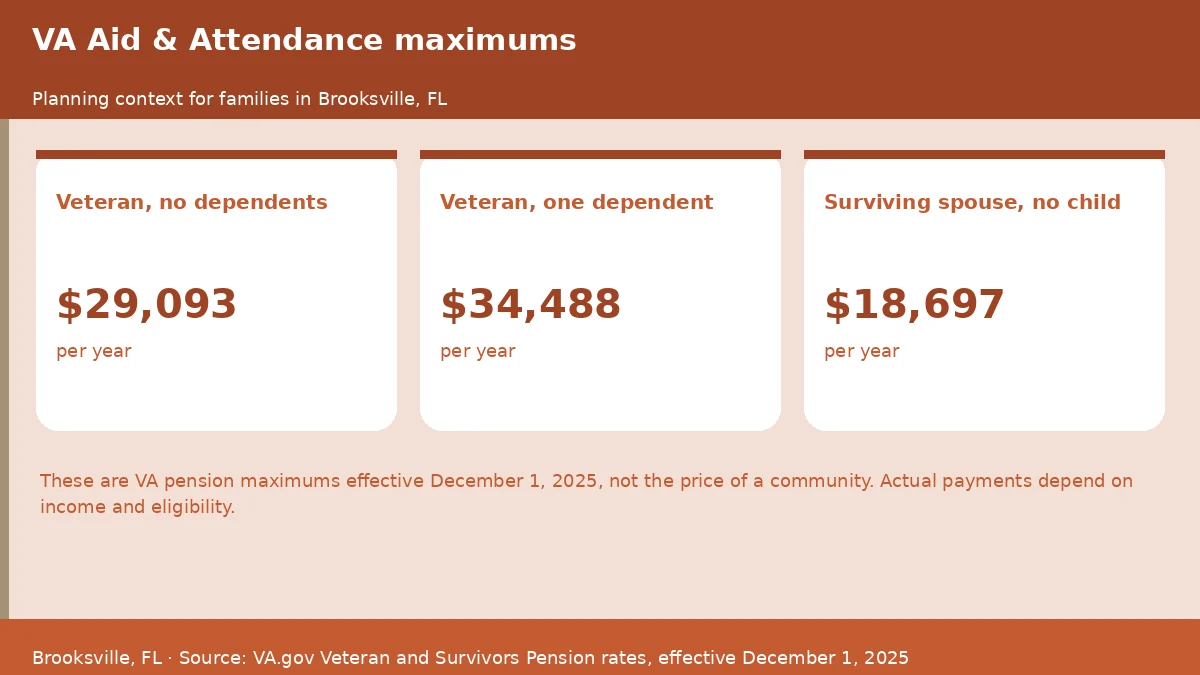
Current VA pension rates list a maximum annual pension rate with Aid and Attendance of $29,093 for a Veteran with no dependents, equivalent to $2,424 per month if countable income were zero. These are maximum pension calculations, not automatic memory care reimbursements. The listed net worth limit is $163,699 for December 1, 2025 through November 30, 2026. VA income, expense and asset-transfer rules require individual review.
Build a budget and consider a respite stay
A practical plan for the cost of memory care in Brooksville FL should separate recurring support from one-time expenses and identify who pays if needs change. Compare written quotes using the same list: personal care, supervision, meals, laundry, supplies, transportation, medication-related services, care-level reviews and planned increases. Keep home-care and residential comparisons on the same schedule of coverage.
A short respite stay can also clarify routines and logistics. The National Institute on Aging describes respite as a short-term break for family caregivers, provided at home, through adult day centers or during residential stays. The the National Institute on Aging also offers respite guidance for dementia caregivers. The Hacienda House offers respite stays; families can ask whether its respite inclusions and assessment process differ from those for a longer stay.
Frequently asked questions
Is there an official memory care cost median for Brooksville?
No. Families can use the metro assisted living median as a planning floor reference and metro nursing home figures as an upper reference. Those benchmarks frame research; they do not predict what a small Brooksville home will charge. A written quote should identify supervision, environment, care levels and other inclusions.
Why can two Brooksville memory care quotes differ so much?
Quotes can reflect different amounts of hands-on personal care, nighttime supervision, staff training, environmental features and group size. The pricing structure also matters. One provider may combine a defined set of services in an all-inclusive charge, while another uses a base amount plus care levels. Ask both providers for written inclusions, reassessment rules and circumstances that could lead to a different recurring charge.
Does Medicare pay for memory care in Brooksville?
Medicare does not cover long-term custodial care when that is the only care needed, and most long-term care is custodial. A dementia diagnosis alone therefore does not mean Medicare will pay residential memory care charges. Families should separate any covered medical services from room, board, personal assistance and supervision, then review Medicaid, insurance, Veterans benefits and personal resources with qualified advisers.
What is different about a small Adult Family-Care Home?
Florida licenses Adult Family-Care Homes separately from larger assisted living facilities. AHCA describes an AFCH as a private home where the licensee lives and cares for residents. The Hacienda House lists itself as an AFCH with 4 beds. Families should still ask about dementia training, daily supervision, environmental safety, care-plan changes and exactly which services are included in its current quote.
Can a respite stay help a Brooksville family plan memory support?
A respite stay can give a family caregiver a short-term break and provide practical experience with a residential routine. It can also prompt specific questions about meals, personal care, supervision and communication. The Hacienda House offers respite stays in Brooksville. Ask for current respite terms and inclusions, and do not assume that a short stay guarantees availability, suitability or pricing for longer-term care.
Talk with The Hacienda House
If you are weighing care options in Brooksville, call (352) 652-8436 or schedule a tour. Our team can talk through current availability, rates and next steps. Please confirm all details directly, since published figures and listings change over time.
Sources
- VA Aid and Attendance and Housebound benefits
- VA pension rates (current)
- Medicare: long-term care coverage
- National Institute on Aging: What is respite care?
- the National Institute on Aging: respite care
- ACL: What is long-term care insurance
- Florida AHCA: Assisted Living Unit
- Florida AHCA: Statewide Medicaid Managed Care Long-Term Care Program
Program rules and benefit amounts were checked on the linked official pages in November 2026 and can change.