Ways to Pay for Assisted Living in Florida: A Guide for Brooksville Families
A practical guide to Tampa Area care costs, private funds, Florida Medicaid, VA benefits, insurance and free guidance for Brooksville families.
Learning how to pay for assisted living in Florida usually means combining several decisions: what care costs near Brooksville, which benefits a relative may qualify for, and how long savings need to last. A useful plan starts with the monthly bill, then separates housing and meals from hands-on care. That distinction matters when comparing private pay, Medicaid, VA benefits and insurance.
For Hernando County families, regional cost figures offer a planning baseline, not a quote. The Hacienda House is a small adult family-care home on Powell Road in Brooksville, offering assisted living style support, memory care support and respite stays. Its size and license make it especially important to ask exactly which services are included and how a change in needs would be handled.
Start with the Tampa Area cost picture
The , based on data collected from July through November 2025, places Brooksville in its Tampa Area region. The survey provides a useful comparison among residential care, help at home, adult day health care and nursing homes. Its assisted living figures are medians, while some home-care monthly amounts are estimates based on the stated hourly rate and schedule.
A smaller home-care schedule may cost less, but it does not necessarily provide supervision throughout the day. Residential and nursing home figures also should not be compared without asking what each includes. These survey amounts are not prices for The Hacienda House. Call the home at (352) 652-8436 for current rates, availability and a written explanation of included services.
How to pay for assisted living in Florida with private funds
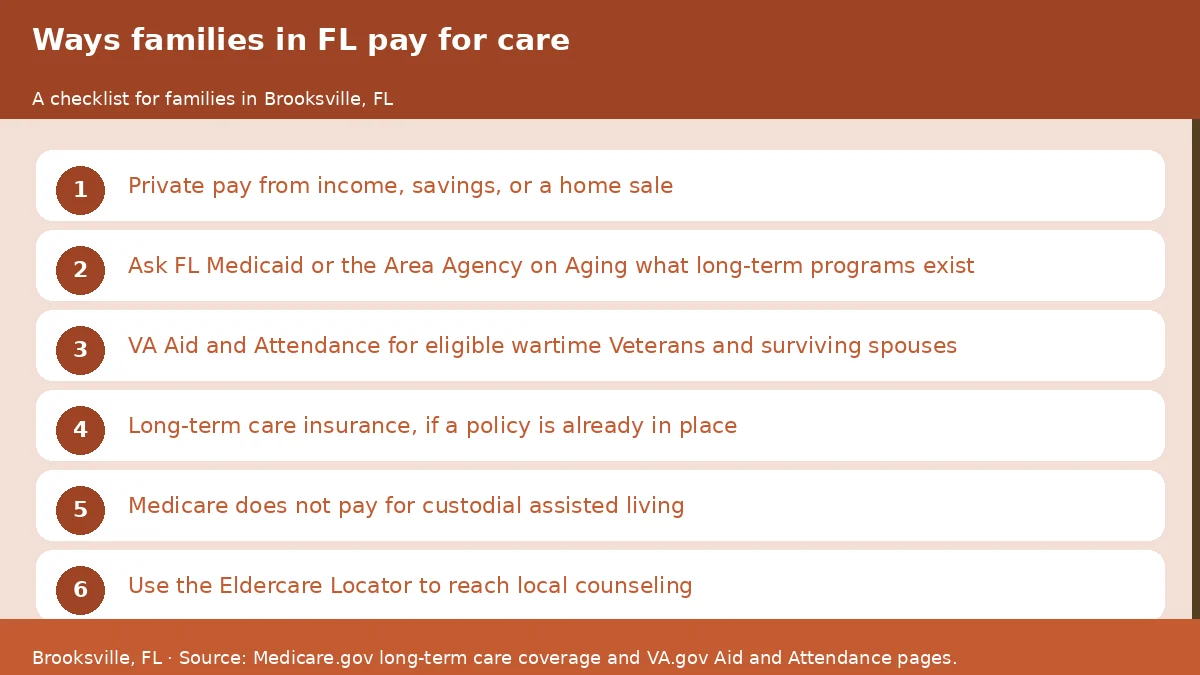
For many Brooksville households, how to pay for assisted living in Florida starts with private funds while benefit applications are explored. List reliable income, accessible savings and any family contributions separately. Then compare those resources with the full agreement, including housing, meals, personal assistance, optional services and possible rate changes. A plan that depends on irregular contributions or immediately spending most available savings may need another layer of funding.
Home equity can be another resource, but the choices carry different obligations. Selling a home may provide proceeds while requiring decisions about timing, taxes and where proceeds will be held. Renting it can add management responsibilities. Borrowing against equity creates repayment requirements, and a reverse mortgage has its own eligibility, occupancy and loan terms. A Florida elder law attorney, tax professional or qualified housing counselor can help review consequences before documents are signed.
When considering assisted living at The Hacienda House, ask for the service agreement rather than building a budget around a single monthly number. Clarify deposits, notice requirements, charges for additional help and what happens if care needs exceed what the home can provide.
Florida Medicaid and the long-term care waitlist
Florida’s Statewide Medicaid Managed Care Long-Term Care program can cover services including assisted living services, personal care, adult day care and respite. Eligibility requires Medicaid financial eligibility, being 65 or older or being 18 or older with a disability, and needing a nursing facility level of care. Financial eligibility and the functional assessment are separate parts of the process.
Coverage of assisted living services is not the same as payment of an entire private-pay bill. Room and board are generally not covered as assisted living services and remain a separate resident responsibility. The managed care plan should explain authorized services, any resident contribution and what the family would still owe. Do not assume that a particular home participates or that approval will cover every charge.
Enrollment is limited, and there is a waitlist. Screening begins through the local Aging and Disability Resource Center, reachable through the Elder Helpline at 1-800-963-5337. Applying early can clarify the process, but it does not guarantee immediate enrollment or placement. Families should also ask how private-pay obligations are handled while an application or waitlist status is pending.
VA Aid and Attendance for eligible Veterans and survivors
VA Aid and Attendance is an increased amount added to a VA pension for qualifying wartime-era Veterans or surviving spouses. Qualifying circumstances can include needing help with activities such as bathing, dressing or eating, being bedridden, living in a nursing home because of lost abilities, or having limited eyesight. It is not an automatic payment based solely on a diagnosis.
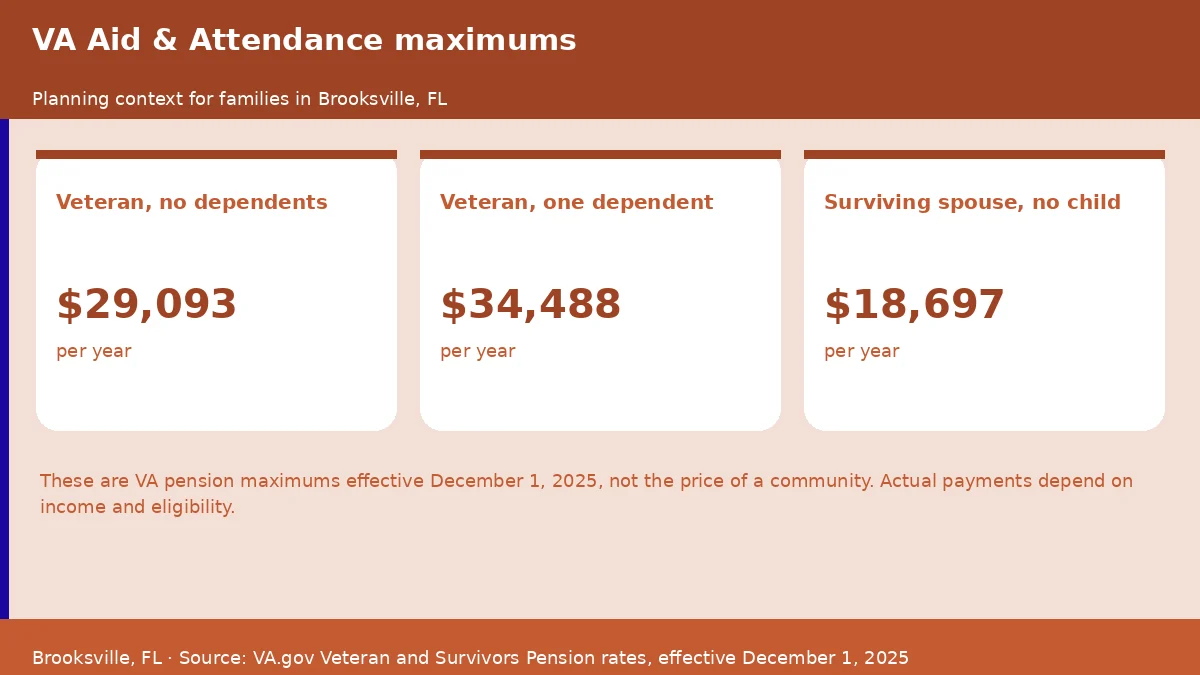
The current VA pension rates list a Maximum Annual Pension Rate with Aid and Attendance of $29,093 for a Veteran with no dependents and $34,488 for a Veteran with one dependent. The pension calculation subtracts countable income from the applicable maximum. Certain unreimbursed medical expenses, which can include care costs, may reduce countable income when VA rules are met.
The VA net worth limit is $163,699 for December 1, 2025 through November 30, 2026. The VA also reviews certain asset transfers before a claim and may impose a penalty period. Families should not transfer property or spend assets solely to qualify without understanding those rules. These Veteran rates should not be assumed to be the rates for every surviving spouse.
Review insurance carefully, and know Medicare’s limits
Long-term care insurance may pay for assisted living, depending on the actual policy. The Administration for Community Living’s insurance overview explains that benefits commonly begin after an elimination period and when the policyholder needs help with activities of daily living or has cognitive impairment. Ask the insurer whether a small adult family-care home is an eligible setting, how benefits are calculated, what documentation is required and whether any exclusions apply.
Medicare plays a different role. According to Medicare’s long-term care coverage guidance, Medicare does not cover long-term custodial care if that is the only care needed, and most long-term care is custodial. Ongoing housing, meals, supervision and help with daily activities should therefore not be budgeted as though Medicare will routinely pay for them. Insurance, Medicare and Medicaid should never be treated as interchangeable benefits.
Use respite to examine the care and payment plan
The National Institute on Aging describes respite care as a short-term break for family caregivers. It may be provided at home, through an adult day center or during a short residential stay. For a Brooksville caregiver, a temporary arrangement can create time for rest or other responsibilities while the family evaluates routines, supervision needs and the practical terms of a longer stay.
The Hacienda House offers respite stays; availability, assessment requirements and included support should be confirmed directly. Memory care support is best evaluated as daily assistance, supervision and environment, not as treatment promising improvement. The the National Institute on Aging’s respite guidance is another planning resource, and its Helpline is 1-800-272-3900.
Find free guidance in Hernando County
Because several public and private systems may be involved, free guidance can help families organize the next steps. The Eldercare Locator, a service of the U.S. Administration for Community Living, connects callers with local Area Agencies on Aging and other aging services. Call 1-800-677-1116 and ask for the agency serving Brooksville and Hernando County.
For Florida long-term care program screening, use the Aging and Disability Resource Center’s Elder Helpline at 1-800-963-5337. Bring insurance policy details, VA documents and a list of current care needs when seeking advice. Ask for written next steps and confirm which office handles financial eligibility, functional screening and waitlist questions. Guidance can clarify options, but it cannot guarantee benefits or a care opening.
Compare the license and agreement, not just the price
Florida licensing distinctions matter when comparing settings. The Florida Agency for Health Care Administration licenses assisted living facilities under Part I of Chapter 429, Florida Statutes. Adult Family-Care Homes are a separate, smaller license type under Part II, based in a private home where the licensee lives and provides care. The Hacienda House’s own site lists it as a Florida Adult Family-Care Home with 4 beds, rather than a large assisted living facility.
Florida also requires Alzheimer’s and dementia training for staff in facilities that advertise memory care. Before signing any agreement, request the license information and written answers about included services, additional charges, rate changes, resident assessments, room and board, respite terms and what happens if needs exceed the home’s authority to provide care. A clear comparison of those terms makes the funding plan more dependable than a headline monthly figure alone.
Frequently asked questions
What is the median assisted living cost near Brooksville?
These are planning benchmarks, not prices for The Hacienda House; families should contact the home directly for current rates and included services.
Does Florida Medicaid pay assisted living room and board?
Florida’s Statewide Medicaid Managed Care Long-Term Care program can cover assisted living services for people who meet Medicaid financial rules and need a nursing facility level of care. It generally does not treat room and board as a covered assisted living service, so those costs remain a separate responsibility. Enrollment is limited and there is a waitlist. Screening starts through the local Aging and Disability Resource Center; eligibility does not guarantee immediate placement.
Can VA Aid and Attendance help a Brooksville family pay for care?
VA Aid and Attendance can add to a VA pension for eligible wartime-era Veterans or surviving spouses who meet care and other requirements. It is not an automatic assisted living benefit. The payment depends on the applicable pension rate and countable income, and certain unreimbursed care expenses may affect that calculation. Brooksville families should verify current rates, net worth rules and asset-transfer rules with the VA or an accredited benefits adviser before making financial decisions.
Does Medicare pay for assisted living in Brooksville?
Medicare does not cover long-term custodial care when that is the only care needed, and most long-term care is custodial. Brooksville families should not expect Medicare to pay an ongoing assisted living bill for supervision, meals, housing or help with daily activities. Long-term care insurance may help if the policy covers the setting and its benefit triggers are met, so review the actual policy rather than relying on its name.
Where can Brooksville families get free benefits guidance?
Brooksville families can start with the Aging and Disability Resource Center’s Elder Helpline at 1-800-963-5337 for Florida long-term care program screening. The Eldercare Locator, at 1-800-677-1116, can connect callers with the local Area Agency on Aging and other aging services. For dementia caregiving support and respite guidance, the the National Institute on Aging Helpline is 1-800-272-3900. These services can help identify next steps, but they cannot guarantee benefits, funding or placement.
Talk with The Hacienda House
If you are weighing care options in Brooksville, call (352) 652-8436 or schedule a tour. Our team can talk through current availability, rates and next steps. Please confirm all details directly, since published figures and listings change over time.
Sources
- VA Aid and Attendance and Housebound benefits
- VA pension rates (current)
- Medicare: long-term care coverage
- Eldercare Locator (U.S. Administration for Community Living)
- National Institute on Aging: What is respite care?
- the National Institute on Aging: respite care
- ACL: What is long-term care insurance
- Florida AHCA: Assisted Living Unit
- Florida AHCA: Statewide Medicaid Managed Care Long-Term Care Program
Program rules and benefit amounts were checked on the linked official pages in November 2026 and can change.
Related reading on this site: